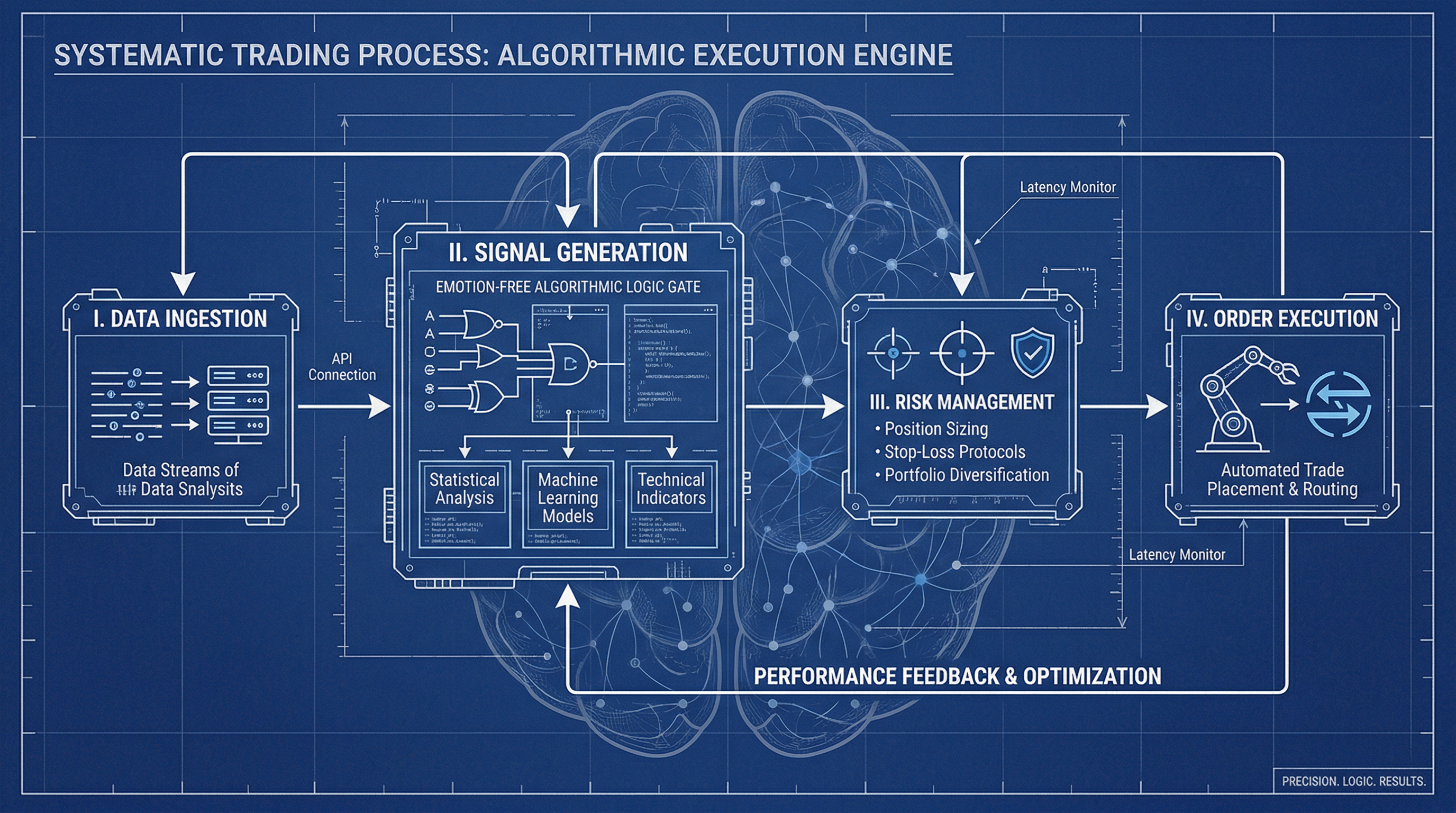
Every trader who has ever lost money knows the problem isn't usually the strategy. The strategy works fine — on paper, in backtests, when you're calm and reviewing charts after the session. The problem is the gap between knowing what to do and doing it when the market is moving, your position is underwater, and every emotion in your body is screaming for you to deviate from the plan. This gap — between intellectual understanding of a process and consistent behavioral execution of it — is the defining challenge of trading psychology. A 2025 study of 2,100 retail traders found that traders who had documented, specific trading processes outperformed those without by an average of 23% annually — not because their strategies were better, but because they executed them more consistently. Process is not just organizational nicety. It's the mechanism by which psychological insight translates into actual P&L improvement.
Why Process Matters More Than Strategy
There are thousands of potentially profitable trading strategies. Most traders who access them never extract their theoretical edge because of inconsistent execution. Research by trading psychologist Brett Steenbarger found that the primary differentiator between profitable and unprofitable traders with objectively similar strategies was the consistency of their execution process — specifically, whether they had a documented process that they followed with measurable fidelity. The implication is sobering: if you're struggling with trading performance, the first question is not "do I have the right strategy?" but "do I have a process that enables consistent execution of whatever strategy I have?"
The 4 Pillars of a Psychologically Robust Trading Process
- Pre-defined entry criteria: Specific, objective conditions that must be met before entering a trade
- Pre-defined risk rules: Maximum position size, stop-loss placement, and daily loss limit — all decided before the session opens
- Execution checklist: A standardized verification sequence before every trade entry
- Post-session review protocol: Systematic evaluation of process adherence, separate from P&L evaluation
A process doesn't eliminate judgment — it structures it. The goal is to eliminate the low-quality, emotionally-driven judgment that occurs during high-stress moments by pre-loading the high-quality, analytical judgment that occurs when you're calm. Traderise's pre-trade checklist and journal are the digital infrastructure that makes process-driven trading operationally practical for real-world trading sessions.
Building Your Entry Criteria: The Specificity Requirement
Vague criteria are not criteria. "I'll buy when the setup looks good" is not a criterion — it's an invitation for System 1 emotional processing to fill the ambiguity with whatever you feel like doing. Specific criteria look like: "I will enter a long position when: (1) price is above the 20-day moving average, (2) RSI is between 40 and 65, (3) a bull flag pattern has formed with declining volume on the pullback, and (4) the broader market is above the 50-day moving average." Every condition has a binary yes/no answer. Either all boxes are checked, or you don't take the trade. Log your criteria in Traderise's trade planner so they're visible before every potential entry.
The Pre-Trade Checklist: Your Emotional Firewall
Research on checklists in high-stakes domains — aviation, surgery, nuclear power — consistently shows they reduce critical errors by 30-80% by creating a mandatory System 2 pause before action. The trading pre-trade checklist serves the same function: it forces deliberate evaluation between impulse and execution. A minimal effective checklist: Does this meet all entry criteria? What is my stop? What is my target? What is my position size? What is my planned response if the trade immediately goes against me? Log the completion of this checklist for every trade in Traderise — the documentation creates accountability.
Trade With Your Brain, Not Against It
Traderise includes built-in trading journals, risk controls, and psychology-aware features designed to help you make better decisions.
Try Traderise FreeRisk Rules That Must Be Pre-Committed
The following risk parameters must be decided before the session opens, not in real time: maximum position size per trade (1-2% of account is the research-backed recommendation), maximum daily loss limit (typically 3-6% of account), maximum simultaneous open positions, and maximum correlation between positions. All of these decisions involve tradeoffs that are best evaluated when calm — not when a position is moving against you and emotion is escalating. Set these parameters in Traderise's risk management dashboard as hard limits, not guidelines.
The Post-Session Review: Where Process Improvement Happens
After each session, conduct a 15-minute review that evaluates three things: (1) Did I follow my entry criteria for every trade? (2) Did I follow my risk rules for every trade? (3) Did I execute my exit rules correctly? Grade your process adherence on a 1-10 scale. Then review P&L — but separately from the process evaluation. This two-metric system prevents the common error of evaluating process quality based on outcomes, which allows good processes to be abandoned after losing sessions and bad processes to be retained after lucky winning ones.
Tracking Process Adherence: The KPI Most Traders Ignore
Your process adherence rate — the percentage of trades where you followed all your rules — is arguably more predictive of long-term trading success than your current win rate or P&L. A trader with 80% process adherence today has a clear improvement path. A trader with 40% adherence who's currently profitable is living on borrowed time. Track this metric monthly in Traderise's performance dashboard and treat it as a primary performance indicator alongside your financial metrics.
The Process Is the Product
The highest-performing traders don't experience their trading as a series of individual bets on market direction. They experience it as the continuous execution of a system — where individual trade outcomes are just samples from a probability distribution, and their job is to ensure the distribution is positive by maintaining the process. This is a fundamentally different relationship with trading than outcome-focused trading — and the research consistently shows it produces better results, lower drawdowns, more consistent behavior, and significantly higher trader wellbeing. Building a documented, measurable, consistently executed process is not the boring part of trading. It is the actual work of trading. Everything else is just research.
Make Your Process Measurable and Enforced
Traderise's pre-trade checklists, hard risk limits, and session analytics transform your trading process from intention to documented, consistently executed reality.
Try Traderise Free