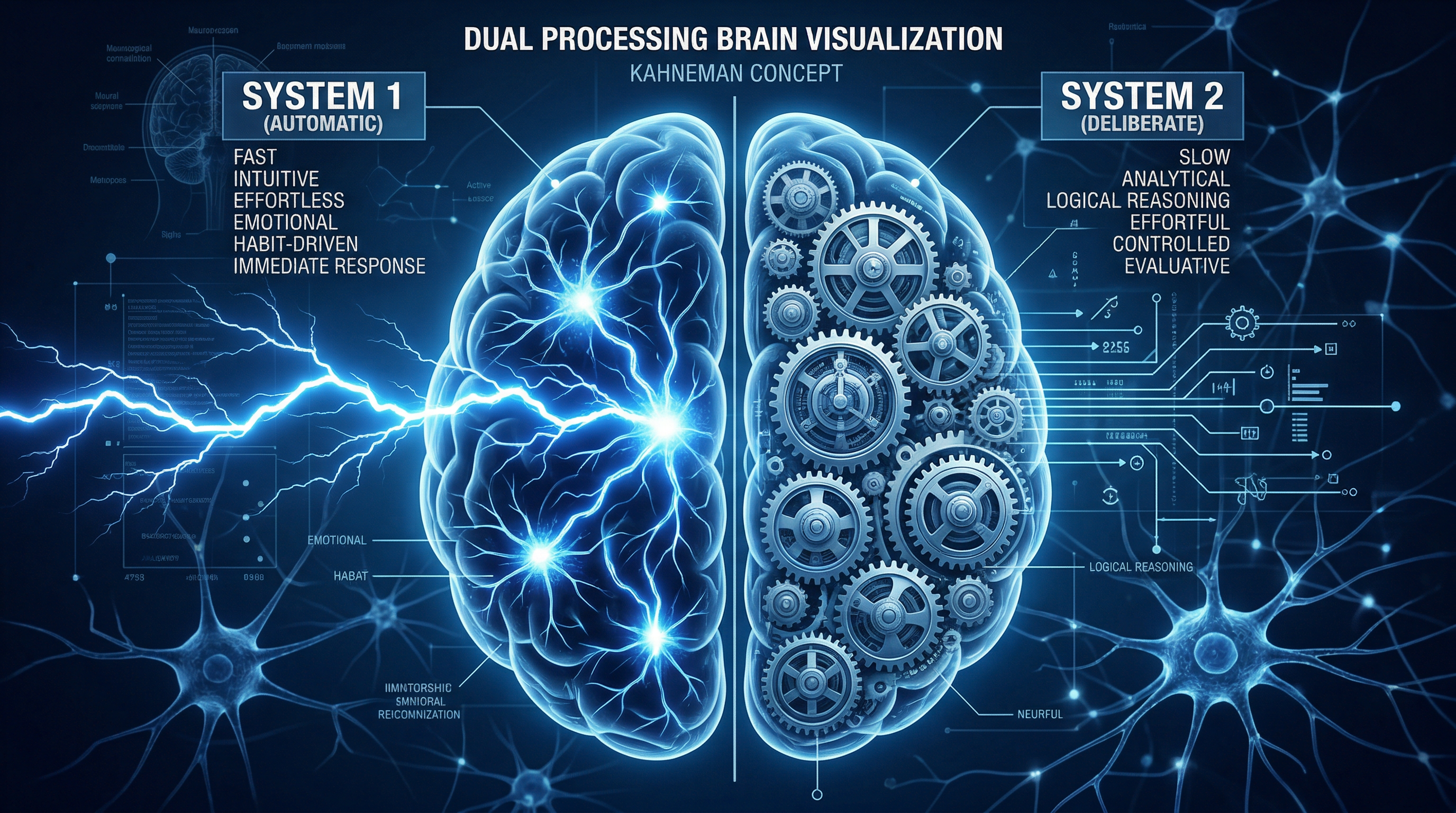
In 2011, Daniel Kahneman published Thinking, Fast and Slow — a book that synthesized decades of psychological research into a single unifying framework that has since become one of the most influential ideas in behavioral economics, performance psychology, and decision science. At its core: human thinking operates on two systems. System 1: fast, automatic, intuitive, effortless, emotional. System 2: slow, deliberate, analytical, effortful, rational. Most people assume the answer for traders is obvious — use System 2, be rational, don't let emotions drive decisions. The reality, supported by emerging neuroscience research, is far more nuanced. The best traders don't eliminate System 1. They develop it, calibrate it, and know exactly when to trust it — and when not to.
The Two Systems: How They Actually Function
System 1 operates continuously, automatically, and without effort. It recognizes faces, detects emotional tones in voices, reads the mood in a room, and produces instant impressions, feelings, and inclinations. It is the product of evolutionary optimization and personal experience — extraordinarily fast but susceptible to systematic biases. System 2 is the deliberate, conscious, effort-requiring analytical process. It follows rules, performs calculations, evaluates options, and catches System 1's errors — when engaged. The critical problem: System 2 is mentally expensive, tires easily, and is often overridden by System 1 before it gets a chance to engage.
What This Means for the Trading Brain
In live trading, the speed of markets, the volume of information, the emotional intensity of financial stakes, and the fatigue of sustained attention all create conditions that strongly favor System 1 dominance. A 2024 neuroimaging study of day traders found that as session length increased beyond 90 minutes, System 2 engagement (measured by prefrontal cortex activity) declined significantly, with System 1-driven decisions becoming increasingly dominant in the final hours of long sessions — exactly when many traders make their worst decisions.
The trading research literature reveals a paradox: expert traders' intuitions are more reliable than beginners' — not less. But beginners can't tell the difference between genuine pattern recognition and emotional noise. The solution is to develop your System 1 deliberately through structured experience, while using System 2 checks to verify it during the developmental phase. Traderise's pre-trade checklist functions as a System 2 override mechanism during moments when System 1 impulses most commonly lead traders astray.
When System 1 Trading Intuition Is Actually Reliable
Research by Gary Klein on "naturalistic decision-making" and by Kahneman himself suggests that System 1 expertise is genuinely reliable under a specific set of conditions: the domain must be regular enough that patterns repeat, feedback must be rapid and clear enough to enable learning, and the practitioner must have had extensive experience in the domain. These conditions are partially, but not fully, met in financial markets. Markets do have regular patterns — but those patterns change over time, feedback is often noisy (a correct decision can produce a loss due to variance), and the information environment is enormously complex. This makes trading one of the harder domains for developing reliable System 1 intuition — but not impossible, particularly for execution and risk-sensing.
When to Trust System 1: 4 Specific Scenarios
1. Execution Timing
Experienced traders often develop reliable System 1 intuition for execution timing — the sense that the market is "ready" to move, or that an entry level is being rejected. This pattern recognition, developed through thousands of hours of screen time, can be faster and more accurate than deliberate analysis for split-second execution decisions. The key condition: this intuition is reliable only in market conditions the trader has extensive experience with. In novel conditions, it must be overridden by System 2.
2. Risk Sensing
Many experienced traders report a visceral discomfort with certain trades that defies articulation — and learn to trust it as a risk signal. A 2025 study found that professional traders' System 1 "discomfort signals" with specific setups correlated with significantly worse-than-average subsequent outcomes, suggesting that implicit pattern recognition was capturing risk information not accessible to conscious analysis. The challenge: distinguishing genuine risk-sensing from mere anxiety (which can block good trades).
Trade With Your Brain, Not Against It
Traderise includes built-in trading journals, risk controls, and psychology-aware features designed to help you make better decisions.
Try Traderise FreeWhen to Suppress System 1: 4 Danger Zones
1. After Emotional Events
Following large losses, big wins, frustrating missed trades, or any period of emotional intensity, System 1 is contaminated by emotional state. Decisions made in these windows are heavily influenced by emotional residue rather than market analysis. Implement a mandatory System 2 check — run through your setup checklist deliberately — before any trade placed within 30 minutes of an emotionally significant event. Use Traderise's mandatory pre-trade checklist to enforce this System 2 override.
2. In Novel Market Conditions
When market behavior is genuinely different from historical norms — unprecedented volatility spikes, new regulatory environments, novel macroeconomic conditions — System 1 pattern recognition is operating without valid reference data. Your intuition is extrapolating from patterns that may not apply. Shift to explicit, deliberate System 2 analysis and reduce position sizes until you've accumulated sufficient new experience to calibrate your intuition to the new conditions.
3. With Large Position Sizes
As position size increases, emotional salience increases — and System 1 emotional processing begins to dominate System 2 rational analysis. For any position representing more than 2-3% of account, implement a mandatory delay and checklist review before entry. The additional time and structure keeps System 2 engaged despite the emotional activation from meaningful financial exposure.
4. At Session Extremes
First 15 minutes and last hour of high-volume sessions are characterized by elevated volatility, reduced liquidity quality, and (for the session's final hour) increased trader fatigue that reduces System 2 engagement. Many professional traders avoid trading in these windows unless they have specific, structurally sound reasons to — and limit their late-session trading strictly to managing existing positions rather than initiating new ones.
Building a System 1 Development Protocol
If System 1 expertise can be genuinely valuable, developing it deliberately matters. The fastest path: structured review of thousands of chart examples in your primary market, immediate feedback on pattern recognition accuracy, and Traderise's performance tracking to identify which of your intuitive reads are actually predictive versus which are noise. With this feedback loop, genuine System 1 trading expertise develops far faster than through unstructured experience alone.
Know When Your Instincts Help and When They Hurt
Traderise's pre-trade checklists, session analytics, and performance tracking give you the data to calibrate when your intuition is reliable — and when to override it.
Try Traderise Free