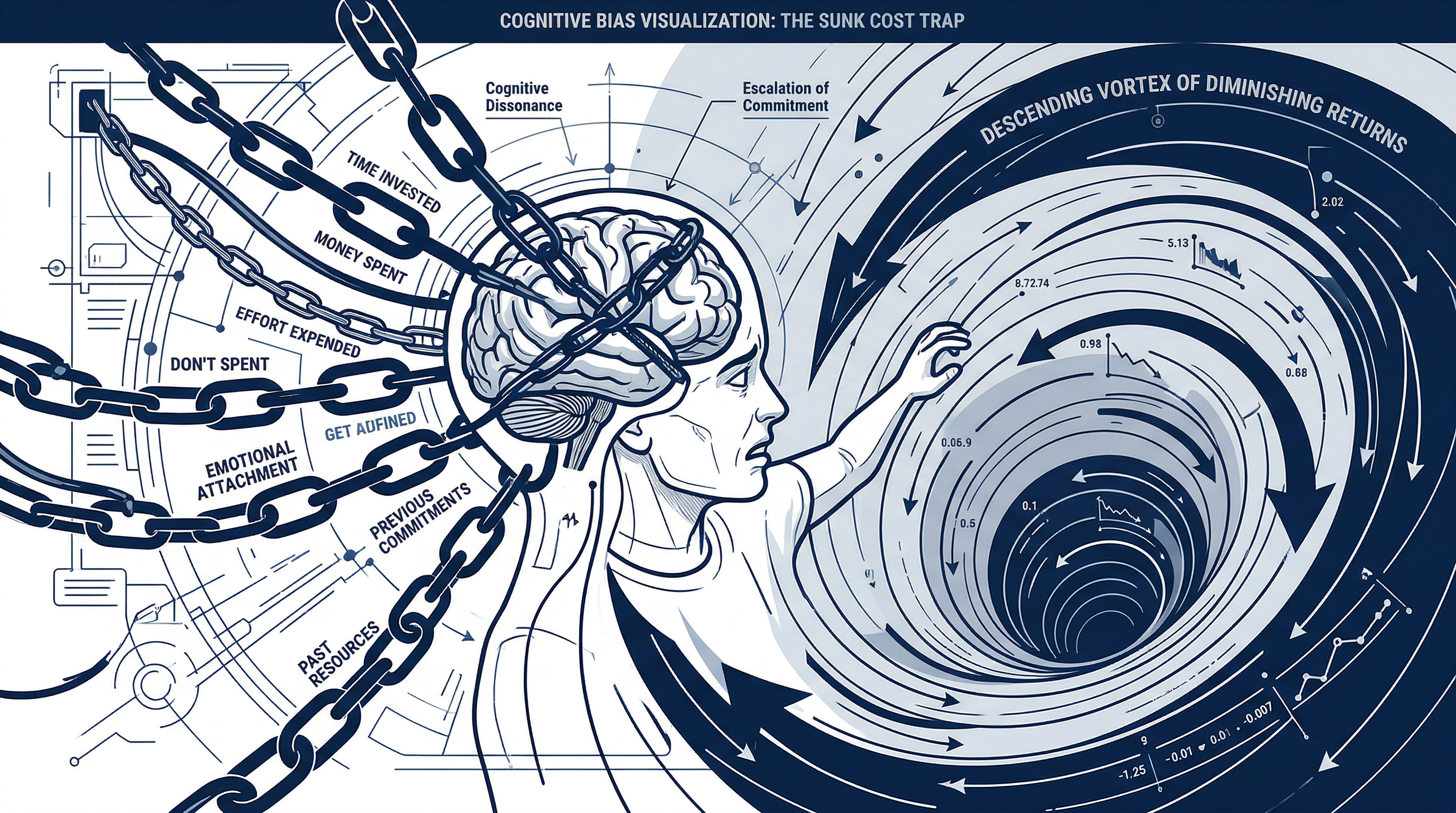
She'd been holding the position for seven months. It had started as a two-week trade. A biotech stock she'd bought ahead of an FDA decision. The decision went badly. The stock dropped 40%. "I'll wait for a recovery," she told herself. It dropped another 20%. "I've already lost this much — selling now would make the loss real." It dropped another 15%. By the time she finally sold, she'd watched a planned $2,000 loss become an $11,000 loss — all because of a cognitive trap so powerful it has destroyed careers, companies, and entire economies. The sunk cost fallacy. And neuroscience now shows it may be the single most expensive mental error in all of trading.
What the Sunk Cost Fallacy Actually Is — And Why It's Not Irrational
The sunk cost fallacy refers to the tendency to continue investing resources in a losing endeavor because of the resources already invested — even when rational analysis clearly indicates cutting losses is optimal. The term was formalized in behavioral economics by Richard Thaler, who won the 2017 Nobel Prize in Economics partly for his work on this phenomenon.
Here's what makes it so pernicious: from an evolutionary standpoint, sunk cost thinking isn't irrational. For most of human history, abandoning an investment — a half-built shelter, a planted crop — was genuinely wasteful. The "don't waste what you've already put in" heuristic kept our ancestors from making impulsive decisions. But in markets, where capital can be instantly redeployed, sunk cost thinking is catastrophically counterproductive.
The Neuroscience: Why Your Brain Physically Resists Selling Losers
A 2024 neuroimaging study from MIT's Sloan School found that contemplating the realization of a paper loss activates the anterior insular cortex — the same brain region associated with physical pain and disgust. Selling a loser doesn't just feel bad. It literally hurts. The brain encodes it as a threat equivalent to physical injury, which triggers avoidance behavior. Holding the losing position, counterintuitively, reduces this pain signal — even as the actual loss grows larger.
3 Flavors of Sunk Cost in Trading
- Time Sunk Cost: "I've researched this company for weeks — I can't just sell."
- Financial Sunk Cost: "I've already lost $5,000 — I need to at least get back to breakeven."
- Emotional Sunk Cost: "I told my friends about this trade — I can't admit I was wrong."
The money you've already lost is gone. It exists only as memory, not as tradeable capital. Every decision about a current position should be made as if you're starting fresh with the current price. Traderise's risk management tools let you set hard stop-loss rules before you enter a trade — locking in rational exit criteria before emotion enters the equation.
The Research Is Shocking: How Much Sunk Cost Actually Costs Retail Traders
A landmark 2025 study analyzing 520,000 retail brokerage accounts found that the average retail trader held losing positions 4.7 times longer than winning positions — a ratio entirely unexplained by fundamental analysis and almost entirely consistent with sunk cost and loss aversion effects. The study estimated that sunk cost-driven holding behavior costs the average retail trader approximately $2,300 per year in avoidable losses.
The analysis also found a concentration effect: the worst 20% of sunk cost offenders — traders who most consistently refused to cut losses — accounted for 71% of all avoidable losses in the dataset. This small group of "chronic holders" reliably turned recoverable drawdowns into account-threatening losses.
The Escalation of Commitment Trap: From Bad to Catastrophic
Sunk cost rarely operates alone. It combines with what psychologists call "escalation of commitment" — the tendency to increase investment in a failing course of action. In trading, this manifests as averaging down: buying more of a losing position to lower the cost basis. A 2026 analysis of retail options trading during the 2025 volatility spike found that 43% of accounts that ultimately suffered drawdowns greater than 50% did so because of repeated averaging down on losing positions — each averaging-down purchase justified by the previous loss already taken.
Using Traderise's position sizing controls to set maximum exposure limits per ticker before you enter prevents this escalation spiral entirely — because the system enforces the rational rule you set when you weren't in the middle of a loss.
Trade With Your Brain, Not Against It
Traderise includes built-in trading journals, risk controls, and psychology-aware features designed to help you make better decisions.
Try Traderise Free5 Strategies Proven to Break the Sunk Cost Cycle
1. The Pre-Mortem Technique
Before entering any trade, imagine it's three months from now and the position has lost 30%. Write down right now: "What would have to be true for me to have been wrong?" This forces prospective thinking that creates permission to exit when those conditions are met. Research by psychologist Gary Klein shows pre-mortems reduce sunk cost commitment by up to 30%.
2. The "Stranger Test"
Ask yourself: if a stranger walked up to you right now with cash and offered to sell you this exact position at the current price, would you buy it? If the answer is no, the only reason you're still holding is sunk cost. This framing resets your reference point to the present and exposes the bias cleanly.
3. Mandatory Stop-Loss Rules Entered Before the Trade
Pre-committed stop-losses, set before entry and logged in a trading journal like Traderise, remove the in-the-moment decision to exit. By the time you hit the stop, the decision has already been made by your calmer, pre-trade self. Research on pre-commitment devices by Thaler and Benartzi shows they are among the most effective known tools for overcoming present-bias behaviors like sunk cost avoidance.
4. Frame Realized Losses as "Tuition"
A semantic reframe with real psychological impact: treat every stop-loss as "paying tuition" for a lesson learned. A 2024 study at the University of Chicago found that traders who journaled losses as "learning costs" rather than "failures" showed 38% lower incidence of sunk cost holding behavior in subsequent trades. The reframe reduces the ego involvement that makes sunk costs sticky.
5. The 48-Hour Rule for Large Positions
For positions that have breached your initial stop criteria but haven't been exited, implement a hard rule: you have 48 hours to either make a documented, evidence-based case for continued holding — or you exit. This forces you to consciously re-evaluate the trade on its current merits rather than its historical cost. Log the evaluation in Traderise's trading journal to create accountability.
Case Study: The GameStop Sunk Cost Spiral of 2025
When GameStop made its second meme run in early 2025, many retail traders who had missed the 2021 event bought in aggressively, convinced they were early to "the next squeeze." When the squeeze failed to materialize and prices began falling, sunk cost psychology locked thousands of traders in. Trading forums filled with posts rationalizing continued holding: "I can't sell now, I'm already down 40%." The average GameStop retail holder who bought in January 2025 and sold in Q2 2025 lost 67% — losses that rational stop-loss discipline would have capped at 10-15%.
The Bottom Line: Dead Money Is Still Money
The most important financial insight you can internalize: money currently tied up in a losing trade that you refuse to exit is not "waiting to recover." It is actively preventing you from deploying that capital into better opportunities. Every day you hold a sunk cost position, you pay two costs: the ongoing loss in the position itself, and the opportunity cost of capital that could be working elsewhere.
The traders who build lasting accounts are not the ones who are never wrong. They are the ones who are wrong cheaply and move on quickly. Build systems — hard stop-losses, pre-trade journals, position size rules — that make being wrong cheap. Traderise's integrated risk controls exist precisely for this purpose. Your future P&L depends not on your ability to pick perfect trades, but on your ability to exit imperfect ones without ego.
Let Your Rules Exit — Not Your Emotions
Traderise's pre-trade risk controls and trading journal lock in your exit criteria before emotions take over — the most powerful defense against the sunk cost trap.
Try Traderise Free