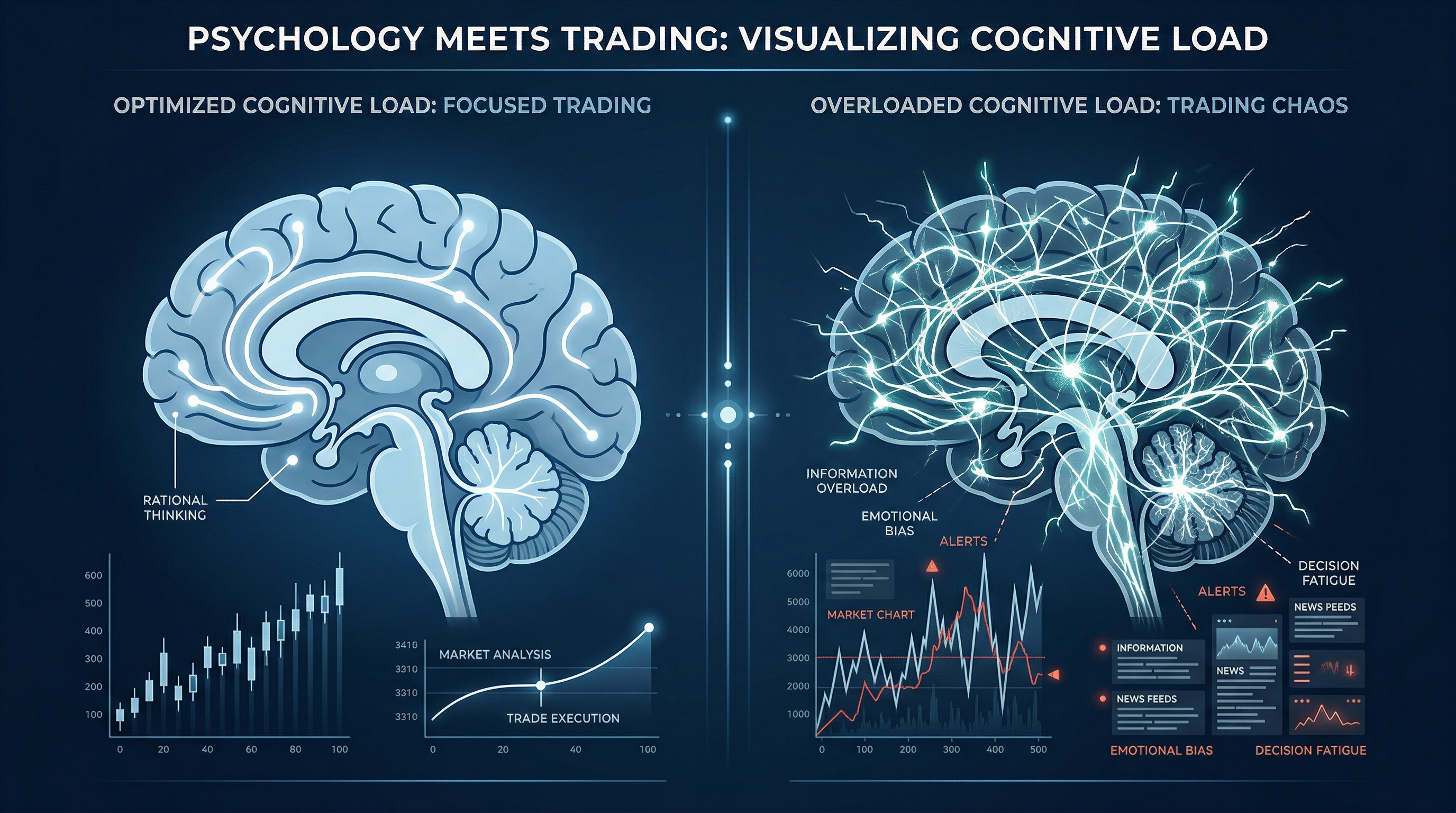
There's a counterintuitive finding hiding in decades of trading psychology research that the financial media almost never discusses: the most complex trading strategies — the ones with dozens of indicators, intricate entry rules, multi-factor screening processes — consistently underperform simpler strategies in the hands of real traders. Not because the complex strategies are worse in theory. Because they impose cognitive demands that systematically degrade execution quality in practice. Cognitive Load Theory, developed by educational psychologist John Sweller in the late 1980s, provides the scientific framework that explains why. And understanding it may be the most practically useful thing you read this year if you've ever wondered why your multi-indicator setup never quite worked as well in real life as it did in your backtests.
What Cognitive Load Theory Actually Says
Cognitive Load Theory is a theory of learning and performance that describes the limits of working memory. Working memory — your brain's active processing space — can hold approximately 4-7 chunks of information simultaneously (Miller's Law, 1956, and its modern revisions). When the cognitive demands of a task exceed this capacity, performance degrades: errors increase, processing speed decreases, and critical information is missed or misprocessed. This overload is what Sweller called "extraneous cognitive load."
In trading, extraneous cognitive load is created by: monitoring too many indicators simultaneously, tracking too many positions at once, processing too many market conditions in parallel, following too many time frames, and making too many discretionary decisions within a single session. When cognitive load exceeds working memory capacity, the brain shortcuts — cutting corners on analysis, relying on heuristics (biases) instead of evaluation, and making errors that a less-loaded version of the same trader would not make.
3 Types of Cognitive Load in Trading Contexts
- Intrinsic load: The inherent complexity of the market and strategy (unavoidable)
- Extraneous load: Complexity created by poor system design, too many indicators, disorganized workspace (reducible)
- Germane load: Mental effort devoted to actually understanding and improving your trading (productive)
The goal is to minimize extraneous load — freeing mental resources for germane learning and intrinsic complexity management. Most complex trading systems dramatically increase extraneous load with no proportional benefit to edge.
A 2025 study found that traders monitoring 5+ indicators simultaneously made 31% more execution errors than those monitoring 1-2 core indicators — even when the multi-indicator traders had more information available. More information is not better if it exceeds cognitive processing capacity. Traderise's clean, focused dashboard is designed to minimize extraneous cognitive load, presenting the critical information you need without the clutter that degrades decision quality.
The Research Evidence: Simplicity Wins in Practice
A 2024 study published in the Journal of Behavioral Finance compared trading performance across strategy complexity levels in a cohort of 1,800 retail traders. Traders using strategies with 1-2 primary entry criteria showed 18% better risk-adjusted returns than those using strategies with 5+ entry criteria — despite the simpler strategies being theoretically less "precise." The gap widened during volatile sessions: in high-volatility periods, simple-strategy traders outperformed by 34%, as the cognitive demands of volatile markets compounded with complex strategy demands to produce more frequent errors in the complex-strategy group.
Separately, research on professional fund managers found that the most successful systematic strategies — the ones actually implemented by Renaissance Technologies, Two Sigma, and other top quant funds — use relatively simple core principles applied with extreme consistency, rather than complex multi-factor approaches. The complexity lives in the infrastructure supporting execution, not in the decision rules themselves.
5 Practical Techniques to Reduce Cognitive Load in Your Trading
1. The 1-2 Core Indicator Rule
Limit your entry decisions to a maximum of 2 primary indicators. Additional indicators can be used for context, but they should not be required for entry — they create decision paralysis and extraneous cognitive load that degrades execution without proportional edge improvement. Audit your current system: how many indicators are truly necessary for your edge, versus how many add complexity without improving outcomes?
2. Standardized Trade Templates
Create a template for each of your primary setups: entry criteria, stop placement method, target method, and exit rules — all standardized. When a setup appears, you're not inventing a decision from scratch; you're applying a pre-solved template. This dramatically reduces extraneous cognitive load by converting complex real-time decisions into template execution. Log these templates in Traderise's trade planner so they're accessible during live sessions.
Trade With Your Brain, Not Against It
Traderise includes built-in trading journals, risk controls, and psychology-aware features designed to help you make better decisions.
Try Traderise Free3. Limit Simultaneous Open Positions
Each open position requires ongoing cognitive monitoring. Research on multi-tasking — which is what managing multiple positions is — consistently shows performance degrades as task count increases beyond 2-3 simultaneously. For most retail traders, 3-5 open positions is near the cognitive capacity limit for maintaining quality oversight. Beyond that, positions are being managed on autopilot rather than active attention — which is when the costly errors occur.
4. Reduce Decision Points Through Pre-Commitment
Every decision you pre-commit before the session opens is one fewer decision you must make during the session under cognitive load. Set your stops, targets, and maximum position sizes before the market opens. Use Traderise's pre-market planning tools to pre-commit as many session decisions as possible, preserving cognitive resources for the genuinely novel situations that require real-time judgment.
5. Physical Workspace Optimization
Environmental distractions — notification sounds, irrelevant browser tabs, cluttered workspace — consume a measurable slice of working memory capacity. Research on open-plan office environments and cognitive performance shows that even unattended background noise reduces working memory by 5-10%. Design your trading environment to minimize every unnecessary cognitive demand: a clean workspace, notification-free devices during session hours, and a dedicated trading area that signals focus mode to your nervous system.
The Simplification Experiment
If you currently use a complex multi-indicator system, run a 30-day experiment: simplify to your 2 most important criteria and track your process adherence and decision quality. Don't evaluate by P&L alone — also evaluate execution accuracy, error rate, and emotional regulation during the session. Most traders who run this experiment report that the simplified system produces comparable or better returns with significantly lower stress, fewer errors, and more consistent execution. Traderise's analytics let you tag trade setups by type so you can compare the simplified system's performance against your historical complex-system performance in an apples-to-apples comparison.
The Counterintuitive Takeaway
More rules, more indicators, and more conditions don't make a trading system more sophisticated. They make it harder to execute with consistency — and consistency of execution is where the real edge lives. The most sophisticated thing a trader can do is understand the cognitive limits within which they operate and design a system that works brilliantly within those limits. That's not simplistic thinking. That's elite thinking applied honestly to the constraints of human cognitive architecture.
A Cleaner System Produces Better Results
Traderise's focused dashboard, pre-trade planning tools, and streamlined analytics reduce extraneous cognitive load — letting you execute your edge with the consistency that drives real performance.
Try Traderise Free