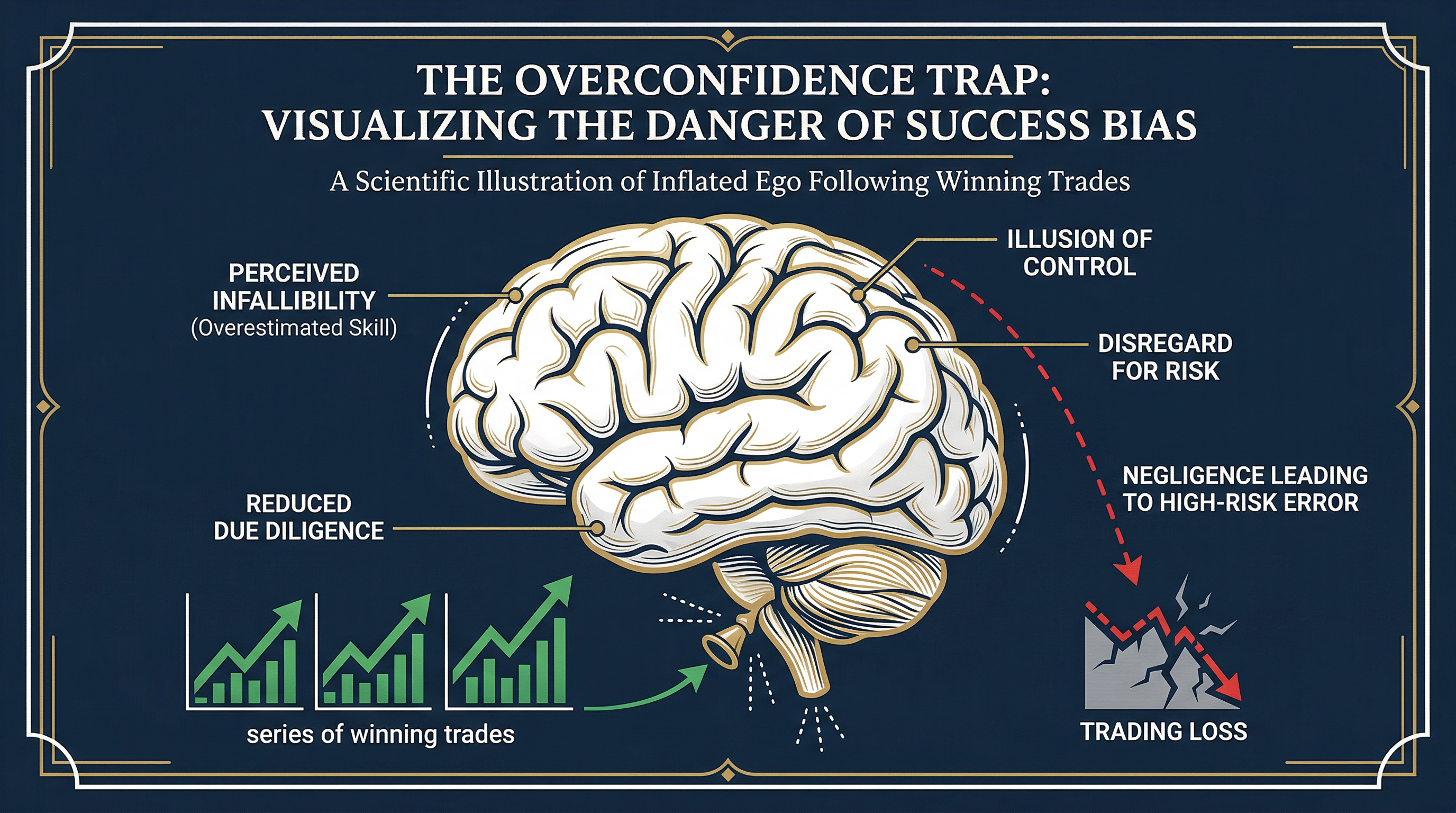
In 2024, a quantitative analysis of 45,000 retail trading accounts uncovered a pattern so consistent it's now called the "Win Streak Bomb": in the 30 days following a trader's longest winning streak, account losses were on average 2.8 times larger than normal. Not because the market got harder. Because the trader got reckless. Overconfidence had transformed a period of edge realization into a setup for catastrophic drawdown. The science behind why this happens is as elegant as it is devastating — and understanding it might be the most important thing you read this year.
The Neuroscience of Overconfidence: What Winning Does to Your Brain
When you win a trade, your brain releases dopamine — the neurotransmitter associated with reward, motivation, and pleasure. This is adaptive: dopamine reinforces behaviors that led to successful outcomes, motivating you to repeat them. But dopamine has a dangerous side effect in the context of trading: it also suppresses risk perception. A 2024 neuroimaging study found that traders who had just experienced winning streaks showed measurably reduced activity in the anterior cingulate cortex — the brain's error-monitoring and risk-detection center — compared to their baseline scans.
Translation: winning literally makes your brain less good at detecting risk. The very success that builds your confidence simultaneously impairs your judgment about what could go wrong next.
Testosterone, Trading, and the Win-Loss-Hormone Cycle
Research by John Coates at Cambridge University, published in his influential book The Hour Between Dog and Wolf, documented a startling hormonal cycle in professional traders: winning trades increase testosterone levels, and higher testosterone correlates with increased risk-taking. Losing trades reduce testosterone and increase cortisol, leading to excessive risk aversion. The result is a biological feedback loop that makes traders systematically overconfident at peaks and systematically overcautious at troughs — exactly the wrong behavioral pattern for profitable trading.
The Overconfidence Manifesto: 6 Things It Makes You Do
- Increase position sizes without new edge evidence
- Skip pre-trade analysis ("I know what I'm doing now")
- Take on trades outside your defined strategy
- Ignore warning signs in your established setups
- Move stop-losses further away to "give the trade room"
- Trade more frequently, reducing average setup quality
A winning streak doesn't prove your edge is larger than you thought. It's often just normal variance in your favor. The correct response to a winning streak is heightened vigilance, not expanded risk. Traderise's risk controls let you set hard maximum daily risk limits that remain enforced regardless of recent performance — your defense against the Win Streak Bomb.
What 45,000 Accounts Revealed About the Win Streak Bomb
The 2024 Retail Trader Behavior Study (Stanford/JP Morgan collaborative research) analyzed position sizing changes in relation to recent performance across 45,000 retail accounts over 18 months. The findings were striking: traders increased position size by an average of 47% following a 5-trade winning streak. Following a 10-trade winning streak, position sizes increased by an average of 118%. Yet win rates in the subsequent trades after these upsizing events were statistically identical to the trader's historical baseline — confirming that the edge hadn't actually improved, only the confidence (and the risk) had expanded.
The asymmetric consequence: when those post-streak positions inevitably experienced normal losses, the inflated position sizes turned ordinary drawdowns into account-threatening events. Platforms like Traderise that enforce consistent position sizing rules mechanically — rather than leaving size decisions to the trader's in-the-moment judgment — provide crucial protection against this dynamic.
The Expert-Beginner Paradox: Why Intermediate Traders Are Most Vulnerable
Counterintuitively, overconfidence is most dangerous not in complete beginners (who often recognize their ignorance) or seasoned professionals (who have developed systematic defenses) but in intermediate traders — those with 6-24 months of experience who have had their first extended winning period. A 2025 study by the CFA Institute found that overconfidence peaks at approximately 12-18 months of trading experience — the exact period when traders feel most competent but still lack the deep understanding of variance and edge that would calibrate their confidence appropriately.
Trade With Your Brain, Not Against It
Traderise includes built-in trading journals, risk controls, and psychology-aware features designed to help you make better decisions.
Try Traderise Free5 Research-Backed Strategies to Protect Against Post-Win Overconfidence
1. The Automatic Post-Streak Size Reduction
Create a hard rule: after any 5-trade winning streak, reduce position size by 25% for the next 10 trades. This is counterintuitive — winning streaks feel like the time to bet more, not less. But the research is clear: winning streaks correlate with subsequent overconfidence-driven losses, not with continued edge improvement. A size reduction creates a circuit breaker that forces the streak's gains to survive contact with your next period of trading. Set this rule in Traderise's risk settings before your next win streak begins.
2. The "Luck vs. Skill" Streak Audit
After any winning streak, conduct a formal audit: for each winning trade, ask "Did this win because I executed my system correctly, or because market conditions happened to favor my position?" If more than 40% of wins were "lucky" — markets moved beyond your thesis's prediction, or you broke your rules and got lucky — adjust down your confidence level accordingly. Real skill is executing the process. Market cooperation is luck.
3. Maintain Immutable Pre-Trade Routines
Overconfidence often first manifests as skipping steps: the pre-trade analysis, the setup criteria review, the risk calculation. Make these routines non-negotiable regardless of recent performance. Log them in a checklist in your Traderise journal before every trade. The day you feel like you don't need the checklist is exactly the day you need it most.
4. Track "Discipline Score" Separately from P&L
Maintain a secondary performance metric: how often did you follow your rules completely, regardless of outcome? A winning trade where you broke your rules is still a procedural loss. A losing trade where you followed your rules perfectly is a procedural win. This two-metric system keeps your evaluation of performance grounded in process quality, not just recent outcomes — which directly combats overconfidence rooted in lucky wins.
5. External Accountability
Share your trading plan and recent performance with a trading partner or mentor. The need to defend your position sizing decisions to someone else creates a social brake on overconfidence-driven risk escalation. Knowing you'll have to explain a 200% position size increase after a winning streak makes it feel less automatic and more considered.
The Professional Edge: How Elite Traders Use Success to Get More Cautious
The counterintuitive hallmark of truly elite traders is that winning streaks make them more careful, not less. Jim Simons of Renaissance Technologies famously implemented automatic strategy de-risking when performance significantly exceeded expectations — precisely because outperformance often signals unusual market conditions, not improved edge. Paul Tudor Jones has described his approach as "paranoid after wins and curious after losses" — the exact inverse of how most retail traders behave.
The insight these professionals have internalized: a winning streak is a data point that warrants investigation, not celebration. Is the edge genuinely stronger? Has market volatility temporarily favored the strategy? Are these wins coming from setups within the system or opportunistic trades outside it? Only after that analysis should position sizing be reconsidered — and even then, incremental changes rather than dramatic escalation.
Win Streaks Won't Kill Your Account — What Comes Next Will
Traderise's automated risk controls enforce consistent position sizing regardless of recent performance — protecting the gains from your best streaks when your brain wants to bet them all.
Try Traderise Free