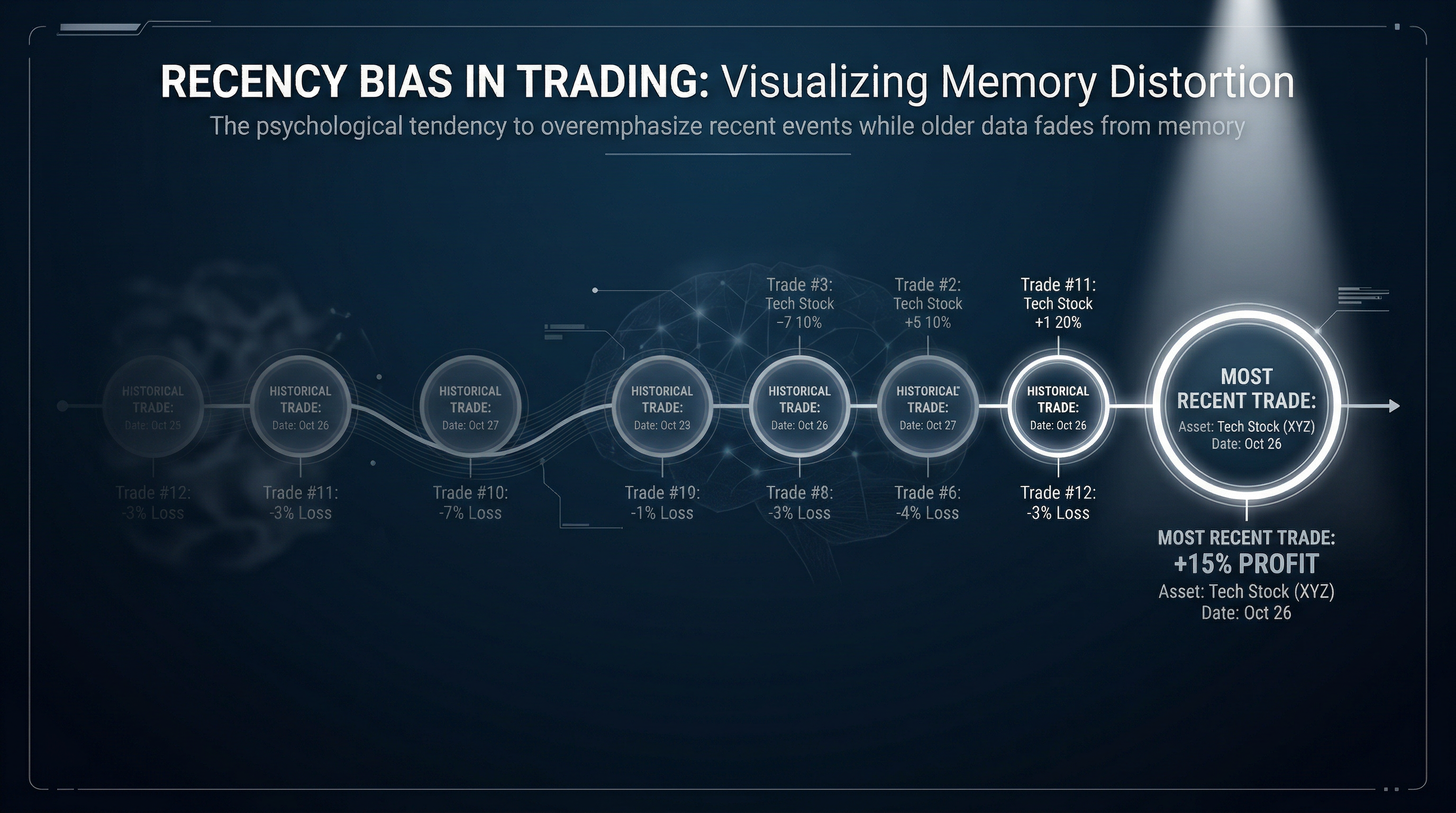
After three consecutive winning trades, a pattern emerges in almost every trader's mind: the feeling that this is working, that the system is hot, that the next trade is going to work too. Position sizes grow. Risk management loosens. Then the fourth trade loses. And suddenly, after that single loss, many traders do the opposite — they shrink their size, second-guess their system, or stop trading altogether. Neither the winning streak nor the losing trade actually changed the underlying probabilities. But your brain rewrote its entire assessment of your strategy's validity based on the last few data points. This is recency bias, and a 2025 study estimates it costs the average retail trader more than overconfidence, more than FOMO, more than almost any other cognitive error in markets.
The Science of Recency Bias: Why Your Brain Overweights the Recent Past
Recency bias is the tendency to weight recent events more heavily than earlier events when forming judgments and making decisions. Psychologically, it stems from the availability heuristic — the mental shortcut identified by Kahneman and Tversky in 1973 — where the ease with which an example comes to mind influences how probable you think it is. Recent events are most easily recalled, so they feel most representative of how things work.
In evolutionary terms, this was adaptive. If a predator attacked your tribe last week, that information should heavily influence your behavior this week. The recent threat is the most relevant threat. But in financial markets, where outcomes are governed by probability distributions that don't change based on recent history, recency bias systematically distorts risk assessment in ways that destroy long-term performance.
The Gambler's Fallacy Twin
Recency bias has an evil twin: the gambler's fallacy. Both distort probability assessment based on recent history, but in opposite directions. Recency bias causes traders to extrapolate recent trends: "It's gone up five days in a row — it's going up tomorrow." The gambler's fallacy causes the opposite: "It's gone up five days in a row — it's due for a reversal." Both errors stem from the same root: treating recent history as predictive when market processes are often far more random than our pattern-seeking brains accept.
Your trading system's edge — if it has one — exists in a distribution of hundreds or thousands of trades, not in the last five. When you change your behavior based on a short streak, you're not responding to evidence. You're responding to noise. Traderise's performance analytics show your rolling statistics across 50, 100, and 200-trade windows — the appropriate timeframes for evaluating edge, not the last three trades.
7 Ways Recency Bias Destroys Trading Accounts
- Post-win size creep: Increasing position size after a winning streak, amplifying the inevitable mean-reversion loss
- Post-loss paralysis: Refusing to trade after a loss or series of losses, missing the recovery
- Strategy abandonment: Ditching a sound strategy after a short losing period that falls within normal variance
- Market regime extrapolation: Assuming current volatility (or lack of) will persist indefinitely
- Sector momentum chasing: Allocating heavily to the last quarter's best-performing sector
- Recency-biased stop placement: Setting stops based on recent volatility without checking longer-term ranges
- Fear of repeat losses: Avoiding the exact setup that just lost, even if the setup itself has positive expectancy
The Data That Will Shock You: How Streaks Actually Work in Trading
A 2025 statistical analysis of 200 trading systems with documented positive expectancy found that 5-loss streaks occur in approximately 30% of all 20-trade sequences, even for systems with a 55% win rate. Seven-loss streaks occur in roughly 8% of 30-trade sequences. Yet when surveyed, traders who experienced 5-loss streaks rated their system's probability of having positive expectancy at an average of just 23% — down from their pre-streak estimate of 74%. The objective probability hadn't changed. The recent experience had entirely rewritten the trader's assessment.
This is why professional fund managers track rolling performance across dozens of market conditions before drawing conclusions about strategy validity. Traderise's analytics tools help retail traders access the same kind of rolling statistical view that helps professionals resist recency-driven strategy abandonment.
Trade With Your Brain, Not Against It
Traderise includes built-in trading journals, risk controls, and psychology-aware features designed to help you make better decisions.
Try Traderise FreeThe 2025 Crypto Cycle That Proved Recency Bias Lives in Bull AND Bear Markets
During the 2024-2025 crypto bull run, retail investors poured record capital into Bitcoin and altcoins in December 2024 and January 2025 — the tail end of a parabolic move — explicitly because of recent performance. Survey data from Coinbase showed that 61% of new crypto accounts opened in January 2025 cited "recent returns" as their primary motivator. When markets corrected 40%+ in Q2 2025, many of those same investors sold at the lows — exactly when the forward-looking probability had shifted back in bulls' favor — because their most recent experience was the decline, which recency bias encoded as "this is how crypto works now."
5 Research-Backed Strategies to Override Recency Bias
1. The 100-Trade Rule
Never evaluate a trading strategy on fewer than 100 trades. Period. Before those 100 trades are complete, you simply do not have sufficient data to distinguish between normal variance and genuine edge deterioration. When you feel the urge to abandon a system after a losing streak, check: how many trades is the current losing streak within, and what does your full-system analysis say?
2. Pre-Set Position Sizing Rules That Don't React to Streaks
Fix your position sizing to a mechanical rule — 1% of account per trade, or Kelly criterion-based sizing — and commit to not deviating from it based on recent performance. The mechanical rule is your defense against post-win size inflation and post-loss size reduction. Log every deviation from your sizing rule in your Traderise journal and review them monthly — these deviations are your recency bias fingerprint.
3. Rolling Statistics Reviews
Create a personal policy: any strategy evaluation must include performance over the last 50 trades, last 100 trades, and last 6 months minimum. Never let yourself make a system decision based on a window shorter than your strategy's minimum meaningful sample. Traderise's analytics dashboard automates this rolling window analysis so you always have the right context available.
4. Historical Base Rate Anchoring
Before every trade, look up the historical base rate of your specific setup — how often has this pattern resolved bullishly over the last 200 occurrences? Using historical base rates counteracts recency bias by giving your brain a longer-timeframe reference point that dilutes the overweighted recent data.
5. Mandatory Post-Streak Reviews
After any streak of 3+ consecutive wins or losses, conduct a mandatory review: "Am I changing my behavior based on this streak? If so, is that change justified by long-term evidence or just recent experience?" Make the review a scheduled event — not an option — in your trading calendar.
The Long Game: Why Recency Is the Enemy of Compound Growth
Compound growth requires consistency across time — not just across favorable recent conditions. The traders who build real wealth don't trade their strategy when it feels hot and abandon it when it feels cold. They apply it systematically, with consistent position sizing, across market conditions that naturally include both winning and losing streaks. Their ability to do this depends entirely on their capacity to resist recency bias — to keep the 100-trade picture in focus when the last 5 trades are screaming a different story. That's not easy. But it's the difference between account growth and account destruction.
See Your Performance Over 100 Trades — Not Just 3
Traderise's rolling performance analytics give you the statistical context to evaluate your edge honestly — so you stop reacting to streaks and start executing your system.
Try Traderise Free