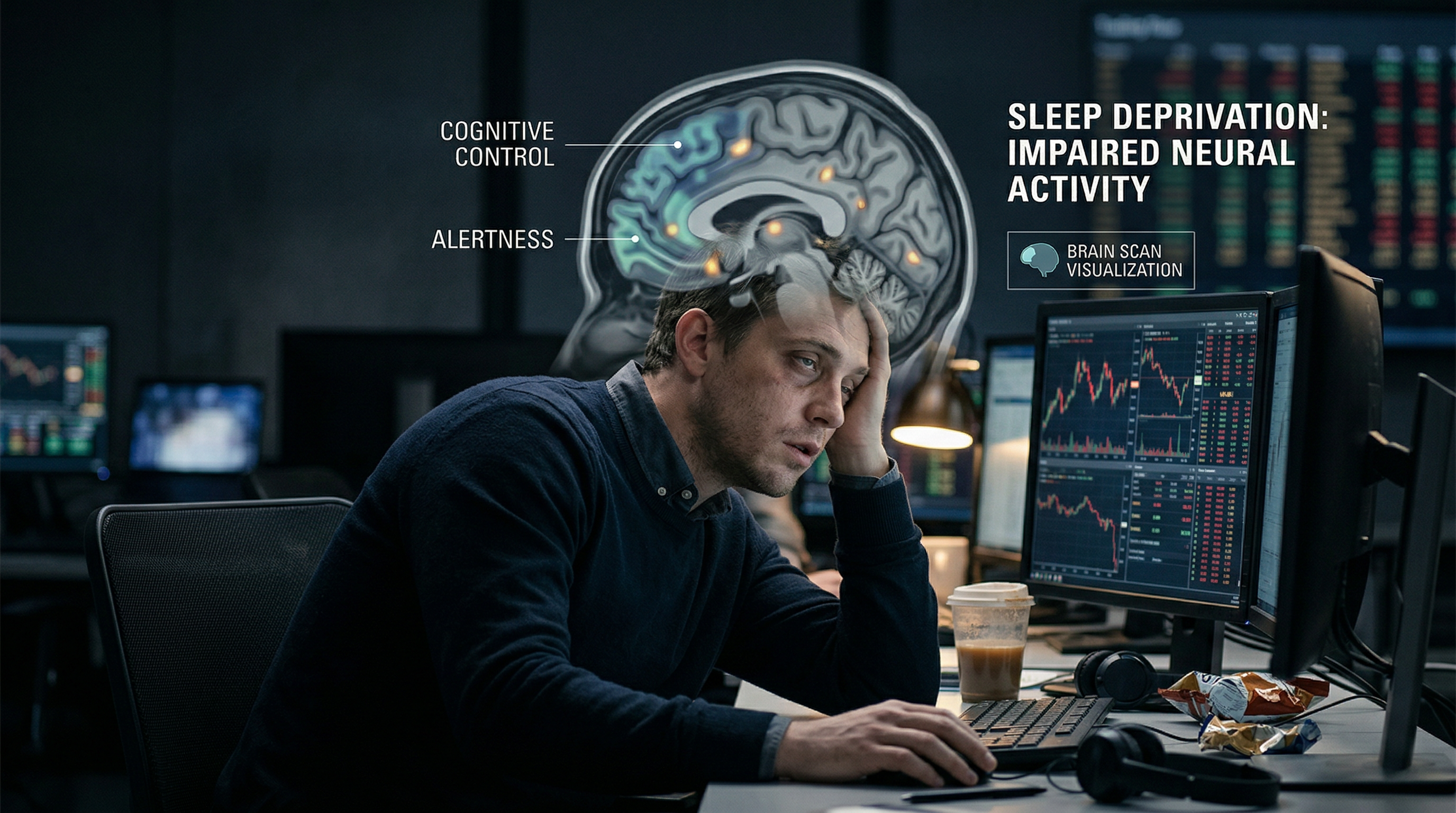
In 2024, a study at the University of Pennsylvania subjected participants to a simulated trading environment under three conditions: full sleep (8 hours), mild sleep restriction (6 hours), and significant restriction (4 hours). The results were striking enough to make any trader reconsider their pre-market routine. Under 6-hour sleep conditions, loss aversion increased by 34% and risk-adjusted decision quality dropped by 23% compared to full sleep. Under 4-hour conditions, risk-adjusted decision quality dropped by 51% — worse than moderate alcohol intoxication by some metrics. And the sleep-deprived subjects consistently reported feeling "fine" and "alert." The most dangerous aspect of sleep deprivation for traders isn't just what it does to your brain. It's that it impairs your ability to notice what it's doing to your brain.
What Sleep Deprivation Actually Does to Your Trading Brain
Sleep is not passive recovery. It is when the brain performs critical maintenance functions essential for high-level cognitive performance: consolidating new information into long-term memory, clearing metabolic waste products from neural tissue (via the glymphatic system, discovered in 2013), regulating emotional processing circuits, and restoring prefrontal cortex function. Matthew Walker, sleep scientist at UC Berkeley and author of Why We Sleep, calls sleep deprivation "the greatest public health challenge we face in the twenty-first century." For traders, it may be the greatest performance challenge they ignore.
6 Specific Ways Sleep Deprivation Destroys Trading Performance
- Impaired risk assessment: The prefrontal cortex, responsible for evaluating risk probability, requires adequate sleep to function — sleep restriction measurably degrades risk calibration
- Increased emotional reactivity: The amygdala becomes 60% more reactive under sleep deprivation, amplifying emotional responses to losses and gains
- Reduced working memory: Working memory capacity — essential for tracking multiple market conditions simultaneously — declines significantly with even one night of restricted sleep
- Impaired pattern recognition: Sleep is when neural pattern recognition systems consolidate — without it, chart reading and setup recognition suffer
- Increased impulsivity: Decreased prefrontal inhibition under sleep deprivation increases impulsive behavior, including revenge trading and position size escalation
- False confidence: Crucially, sleep-deprived subjects consistently overestimate their own cognitive performance — the meta-cognitive blindness problem
A 2025 study found that one night of 5-hour sleep impaired trading performance equivalent to a 0.05% blood alcohol content — just below legal driving limits in most jurisdictions. You wouldn't drive drunk. You probably shouldn't trade on 5 hours of sleep either. Traderise's daily risk limit settings provide a safety net for the sessions where sleep deprivation has already impaired your judgment before you realize it.
The Research That Should Change Every Trader's Evening Routine
A 2025 longitudinal study tracking 890 active traders over 12 months correlated sleep data (from wearable devices) with trading performance metrics. The findings: traders averaging 7+ hours of sleep showed 31% better Sharpe ratios, 27% lower maximum drawdowns, and 44% less revenge trading behavior compared to those averaging under 6 hours. The relationship held after controlling for experience, strategy type, and market conditions. Sleep was, statistically, one of the single strongest predictors of trading performance in the dataset.
Perhaps most remarkably, the study found no evidence that traders adapted to chronic sleep restriction — performance degraded consistently throughout the year for short-sleepers, with no sign of tolerance developing. Your brain doesn't get used to inadequate sleep. It just gets progressively worse at its job.
Practical Sleep Optimization for Traders
The Pre-Market Cutoff Rule
One of the most common sleep disruptors for active traders is late-night chart review and news consumption. The anxiety about overnight positions activates the stress response system, suppressing melatonin production and delaying sleep onset. Implement a hard pre-market cutoff: no charts, no financial news, no P&L checking after 9 PM. Set a Traderise alert for any positions approaching your stop level so you don't need to monitor manually — enabling you to actually disconnect.
Temperature, Darkness, and Consistency
Sleep research consistently identifies three environmental factors as most important: cool room temperature (65-68°F / 18-20°C), complete darkness, and a consistent sleep/wake schedule. The consistency factor is particularly important for traders: irregular sleep schedules (late nights one day, early wake-ups the next) disrupt circadian rhythm and produce sleep quality far worse than total sleep time would suggest.
Trade With Your Brain, Not Against It
Traderise includes built-in trading journals, risk controls, and psychology-aware features designed to help you make better decisions.
Try Traderise FreeThe Post-Lunch Trading Danger Zone
Human circadian biology includes a natural alertness dip between 1-3 PM — independent of sleep quality. Decision-making research finds this window consistently produces the worst judgment across cognitive tasks. For most traders, the post-lunch window is the highest-risk trading period of the day. Consider whether your strategy requires you to be active during this window, and if so, implement additional risk safeguards during these hours.
What to Do When You've Already Slept Poorly
Sometimes poor sleep is unavoidable — illness, a newborn, genuine insomnia. On days after poor sleep, implement the following protocol: reduce maximum position size by 50%, increase your pre-trade routine to include additional physiological preparation (cold water, exercise), set tighter daily stop-loss limits, and increase your use of pre-committed decision rules to compensate for reduced in-the-moment judgment capacity. Log in your Traderise journal that this was a poor-sleep day so you can track its performance impact over time. And honestly consider whether a particular day is simply a "watch and learn" session rather than a live trading session.
The Competitive Advantage No One Talks About
Here's the irony of sleep deprivation in trading culture: late-night research sessions and early alarm clocks to catch pre-market action are often worn as badges of dedication. But the research suggests that the trader who consistently sleeps 7-8 hours has a measurable neurological advantage over the "dedicated" trader who sleeps 5-6. The competitive edge isn't in working more hours. It's in having a brain that performs at its highest capacity during the hours that matter most — the live market session. Sleep is not a lifestyle luxury. It is a performance-critical investment in your primary trading instrument: your brain.
Protect Your Performance — Start With Your Sleep
Traderise's alert systems, daily loss limits, and session analytics help you trade safely even on suboptimal days — and build the evidence base that shows you when your performance is compromised.
Try Traderise Free