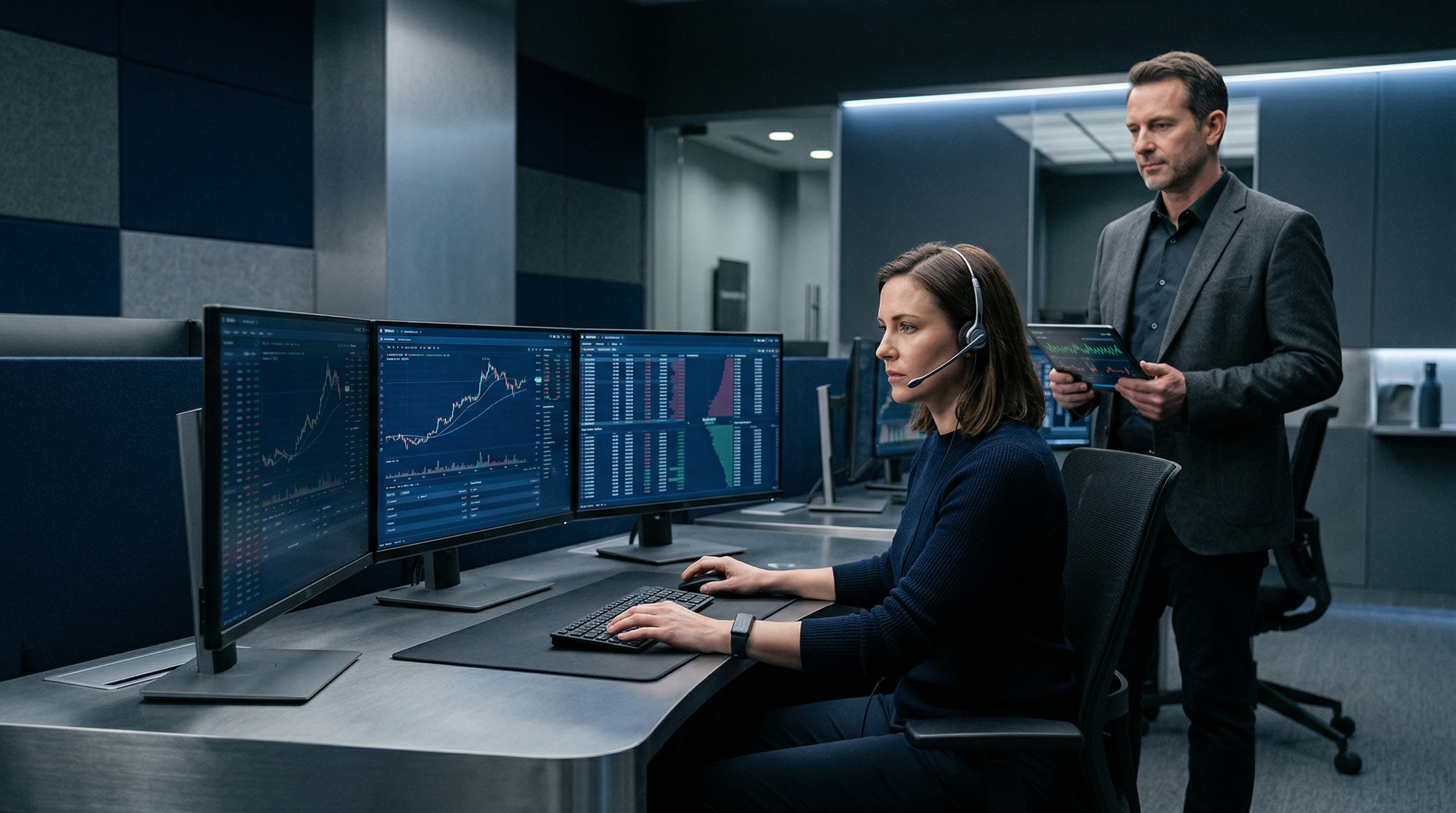
Navy SEALs who complete BUD/S training — one of the most grueling selection processes in the world — are not tougher because they were born that way. They're tougher because they were systematically exposed to controlled stress until their nervous systems learned to function under conditions that would incapacitate most people. The process is called Stress Inoculation Training, and it was developed by psychologist Donald Meichenbaum in the 1970s. What almost no one in the trading world talks about is that the exact same neurological adaptation that makes SEALs effective in combat is what separates traders who maintain discipline during market crashes from those who panic and blow up their accounts. The good news: you can train this. Here's how.
What Stress Inoculation Training Actually Is
Stress Inoculation Training (SIT) is a psychological intervention developed by Dr. Donald Meichenbaum and refined over decades in military, athletic, and medical contexts. Like a vaccine introduces small doses of a pathogen to build immune resistance, SIT exposes individuals to graduated levels of stressors — real or simulated — to build psychological and physiological resilience before they face actual high-stakes situations.
SIT operates through three phases: conceptualization (understanding the stress response), skills acquisition (learning coping techniques), and application (practicing under progressively realistic conditions). A 2025 meta-analysis published in Applied Psychology covering 83 studies found that SIT reduced performance degradation under stress by an average of 37% compared to control groups across military, surgical, and athletic domains.
The Neuroscience: What Stress Does to Your Trading Brain
Under acute stress, the hypothalamic-pituitary-adrenal (HPA) axis floods your bloodstream with cortisol and adrenaline. These hormones shift neural processing from the prefrontal cortex — your seat of rational, long-term thinking — to the amygdala, which specializes in rapid, emotionally-driven threat responses. A 2024 study at the Max Planck Institute found that under moderate financial stress, subjects showed a 23% reduction in working memory capacity and a 31% increase in risk-seeking behavior (in attempts to recover losses). Under high stress, rational decision-making essentially collapsed.
This is why traders who haven't deliberately trained stress tolerance consistently make their worst decisions during their most important moments — major drawdowns, volatile market opens, fast-moving news events.
3 Phases of Stress Inoculation Applied to Trading
- Phase 1 — Education: Understand how your specific stress response manifests. Do you freeze? Overtrade? Become rigid? Identify your pattern.
- Phase 2 — Skills Acquisition: Learn and practice physiological regulation techniques (tactical breathing, progressive relaxation) and cognitive reappraisal.
- Phase 3 — Application: Deliberately expose yourself to progressively realistic trading stress in controlled settings before trading real capital in volatile conditions.
The market doesn't care how well you trade when it's calm. It only cares how you perform when everything is moving fast and every decision feels urgent. Stress inoculation is the practice of preparing for those moments before they happen. Traderise's paper trading environment provides a low-stakes arena to simulate high-volatility conditions — a critical part of any trader's stress inoculation protocol.
The Military Research That Applies Directly to Trading
A landmark 2023 study of US Army Special Forces candidates found that those who received six weeks of SIT prior to combat simulation training showed stress hormone levels (cortisol, adrenaline) that were 40% lower during peak-stress scenarios compared to control groups who didn't receive SIT. More importantly, their task performance under maximum stress was 52% better — they made better decisions when it mattered most.
A 2025 application study at the University of Amsterdam applied equivalent training to a cohort of 120 retail traders preparing to trade a live volatile market event. Those who completed the SIT protocol made significantly better risk management decisions during the event — with 34% lower incidence of panic selling and 28% lower maximum drawdown during the event — compared to the control group.
5 Stress Inoculation Techniques Specifically for Traders
1. Scenario-Based Pre-Visualization
Before each trading session, spend 5-10 minutes vividly imagining the worst-case scenario that could occur: a flash crash, a gap against your position, a news event that destroys your thesis overnight. Walk yourself through exactly what you will do in each scenario, step by step. This mental rehearsal primes your neural circuits for a controlled response rather than a panic reaction. Elite traders like Mark Douglas, author of Trading in the Zone, have long recommended this practice — and neuroscience now confirms why it works: mental rehearsal activates many of the same neural pathways as actual experience, building stress resilience without real-money risk.
2. Tactical Breathing Protocols
The US military's "box breathing" technique (4 counts in, 4 counts hold, 4 counts out, 4 counts hold) has documented physiological effects: it activates the parasympathetic nervous system, reducing cortisol and adrenaline within 2-3 minutes. A 2025 clinical study found that traders who practiced box breathing for 5 minutes before market open showed 22% lower cortisol levels during the first 30 minutes of trading — the highest-volatility window — compared to those who didn't. Make this your non-negotiable pre-trading ritual.
3. Graduated Live Exposure
Don't jump straight from paper trading to full-size live trading in a volatile market. The stress gap between these two environments is enormous, and it's exactly the gap where most traders' discipline breaks down. Use Traderise's simulation environment to practice in realistic conditions with emotionally meaningful (but manageable) stakes. Gradually increase position sizes as you confirm your stress response is managed.
4. Post-Stress Recovery Protocols
Develop a specific end-of-session routine for high-stress trading days: physical movement (even a 10-minute walk), a brief written debrief of decisions made under pressure, and a deliberate "close" to the trading day that signals to your nervous system that the threat has passed. Without active recovery, stress responses accumulate, degrading decision quality progressively across the week.
5. The "Stress Journal" Practice
Keep a separate log that records your subjective stress level (1-10) at trade entry, during the trade, and at exit. Over time, this reveals your stress-performance relationship: what stress levels correlate with your best decisions? Your worst? Many traders find that a moderate stress level (4-6) produces optimal performance, while very low stress (complacency) or very high stress (panic) produce their worst outcomes. Using Traderise's trading journal to track stress alongside performance metrics creates a personalized map of your optimal performance zone.
Trade With Your Brain, Not Against It
Traderise includes built-in trading journals, risk controls, and psychology-aware features designed to help you make better decisions.
Try Traderise FreeBuilding a Full Pre-Market Stress Inoculation Routine
The ideal pre-market routine for stress-resilient trading takes 20-30 minutes and includes: a review of the prior day's key emotional moments (not just P&L), identification of today's highest-stress scenarios and your planned responses, a physiological preparation sequence (breathing, brief movement), and a final check of your rule set against today's conditions. Log this routine completion in Traderise's pre-trade checklist — the act of logging creates accountability to the process.
The Long-Term Payoff: Trading as a Stress-Resilient Discipline
Stress inoculation is not a quick fix. Like physical fitness, it requires consistent practice to build and consistent maintenance to preserve. Traders who invest in this training — systematically, over months — develop something that no technical analysis course can teach: the ability to execute their system at their highest level of competence during the exact moments when the stakes are highest and the psychological pressure is greatest.
That ability — performing under pressure — is ultimately what separates the traders who build accounts over years from those who perpetually destroy them during every significant market event. The SEALs train for the worst-case scenario not because it's likely but because when it happens, their response is the only thing that determines the outcome. For traders, the same principle applies. The next market crash is coming. The question is whether you've done the training.
Build the Mental Fitness to Trade at Your Best When It Matters Most
Traderise's simulation environment, structured journaling, and risk controls give you the practice arena and accountability framework your stress inoculation training requires.
Try Traderise Free