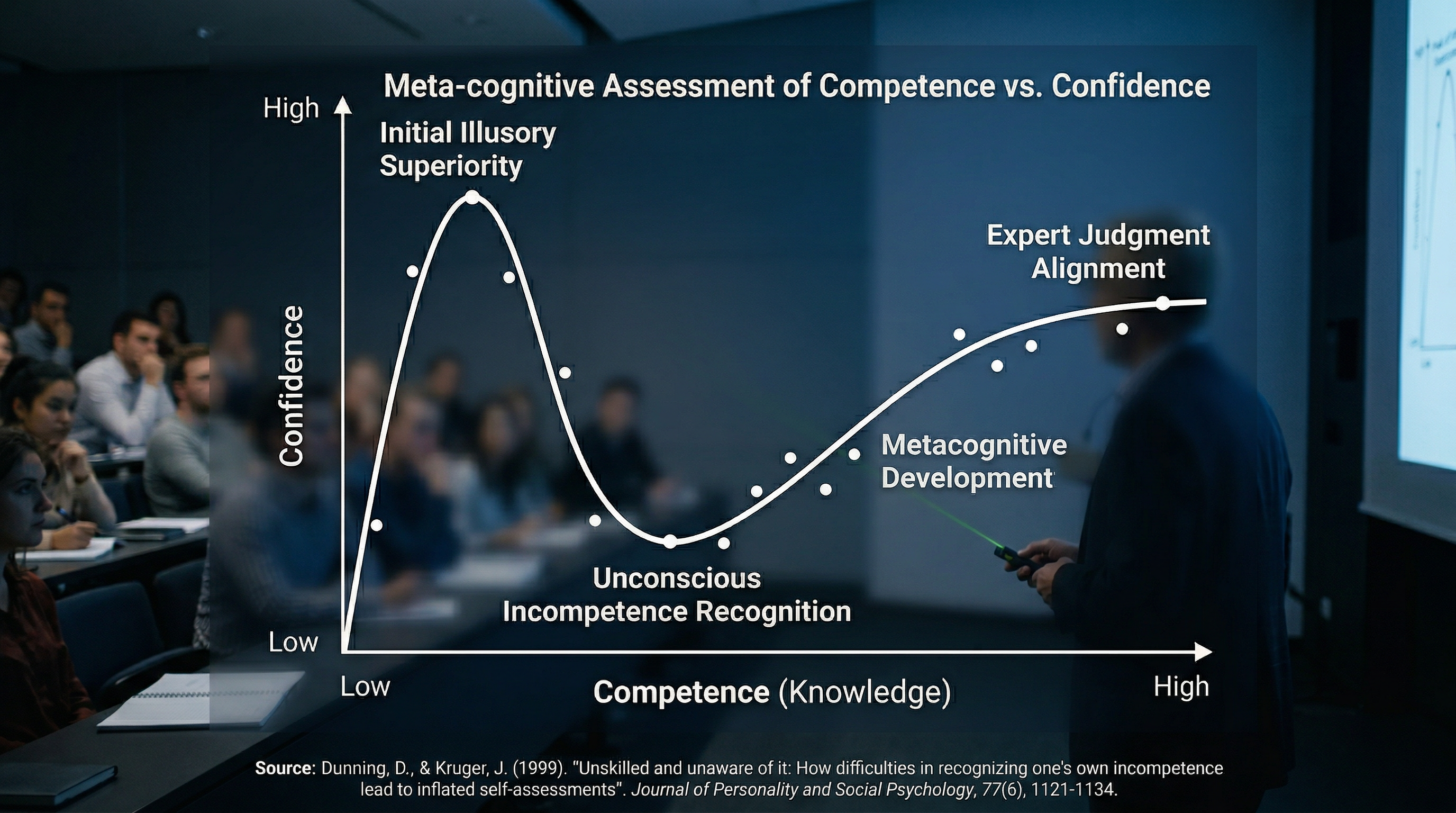
In the first month of trading, most people feel a quiet, terrifying confidence. The charts make sense. The patterns seem obvious. "I don't know what all the fuss is about," one trader told me after his first two weeks of paper trading profits. Eighteen months later, he'd blown up two accounts. His problem wasn't bad luck. It was that he never moved past what researchers now call the "peak of Mount Stupid" — the treacherous summit of the Dunning-Kruger curve where a tiny bit of knowledge produces maximum overconfidence. In trading, that peak is where money goes to die.
The Science Behind Dunning-Kruger: Why Incompetence Is Invisible to Itself
In their landmark 1999 paper "Unskilled and Unaware of It," David Dunning and Justin Kruger at Cornell University demonstrated that people with limited knowledge in a domain systematically overestimate their own competence — precisely because they lack the metacognitive ability to recognize what they don't know. The original study used logic tests, grammar, and humor, but subsequent research has extended the finding across virtually every complex skill domain, including financial markets.
A 2025 study published in the Journal of Financial Psychology applied the Dunning-Kruger framework to a cohort of 2,400 retail traders over 18 months. Traders with 3-6 months of experience showed the highest self-rated confidence scores — higher even than experienced traders with 5+ years of track records. Yet their actual returns were the worst in the sample, averaging -34% annualized. The researchers called this the "Confident Beginner Paradox."
The 4 Stages Every Trader Must Survive
- Unconscious Incompetence: You don't know what you don't know. Everything looks easy. This is peak Dunning-Kruger territory.
- Conscious Incompetence: You start losing money and realize the markets are genuinely complex. Painful but necessary.
- Conscious Competence: You're developing real skills but must consciously apply them. Slow but profitable.
- Unconscious Competence: Good process becomes automatic. The mark of a professional trader.
Most traders quit during Stage 2. Of those who push through, tracking every trade with a structured journal on Traderise is one of the fastest ways to accelerate through Stages 2 and 3 — because it confronts you with objective performance data rather than selectively remembered wins.
Why Beginner's Luck Is Dunning-Kruger's Evil Twin
Bull markets are a Dunning-Kruger accelerant. When everything is going up, novice traders mistake market beta for personal skill. A 2024 analysis of Robinhood account data found that during the 2023 AI-driven rally, 68% of new accounts were profitable in their first 90 days — leading to significantly increased position sizing and reduced diversification heading into Q4 2023's correction. The "skill" they thought they had was actually just a rising tide. Dunning-Kruger had turned a favorable market environment into a confidence trap.
The most dangerous moment in a trader's career is their first winning streak. Neuroscience shows that early wins trigger dopamine responses that encode "I am good at this" as a core belief — before you've had enough experience to test whether that's true. Traderise's performance analytics separate luck from skill by benchmarking your returns against market conditions — a vital reality check during bull runs.
7 Warning Signs You're Living on Mount Stupid
- You explain your trades in terms of patterns, but can't quantify your edge statistically
- You feel impatient with risk management discussions ("I already know this stuff")
- Your position sizes have been growing without a corresponding increase in win rate
- You've never calculated your actual expectancy (average win × win rate - average loss × loss rate)
- You attribute losses to bad luck and wins to skill, consistently
- You've started giving trading advice to friends after fewer than 12 months
- The idea of a trading journal feels unnecessary ("I remember my trades")
What the Research Says About How Long It Takes to Actually Know Markets
A 2025 meta-analysis of professional trader development, published in Frontiers in Psychology, synthesized data from 47 studies covering over 12,000 traders across asset classes. The findings were sobering: meaningful statistical edge requires a minimum of 200-300 trades in consistent market conditions to even begin distinguishing skill from variance. Most retail traders make fewer than 50 trades before drawing conclusions about their ability.
The study also found that traders who kept structured performance journals — logging not just trades but the reasoning behind each decision — reached genuine competence 40% faster than those who didn't. The journal creates the feedback loop that the brain needs to calibrate its self-assessment. Traderise's integrated journal is built specifically for this kind of structured reflection.
Trade With Your Brain, Not Against It
Traderise includes built-in trading journals, risk controls, and psychology-aware features designed to help you make better decisions.
Try Traderise FreeThe "Expert Beginner" Problem in Trading Communities
Online trading communities — Reddit, Discord, Twitter/X — have created a new variant of Dunning-Kruger: the Expert Beginner, someone who has been losing money for 2-3 years but has acquired enough vocabulary to sound authoritative. They use terms like "liquidity sweep," "order flow," and "market structure" fluently, but their accounts are consistently negative. A 2025 survey of 1,800 active members of major trading subreddits found that 64% had never calculated their own expectancy and 71% couldn't accurately recall their win rate from the prior six months.
The vocabulary of expertise is not expertise. What separates genuinely skilled traders is not terminology — it's calibrated uncertainty. The best traders are acutely aware of what they don't know.
How Experts Think Differently: The Calibration Advantage
Research by Philip Tetlock, detailed in his 2015 book Superforecasting, identified that expert forecasters — people who are genuinely better than chance at predicting complex outcomes — share one trait above all others: they are well-calibrated. When they say they're 70% confident in something, they're right about 70% of the time. Dunning-Kruger sufferers, by contrast, say they're 90% confident and are right 50% of the time.
In trading terms: experts know their win rate, their average R:R, their performance in different market conditions, and their psychological weak points. Beginners know none of these things — but feel certain they understand the market.
3 Antidotes That Actually Work (Backed by Research)
1. Probabilistic Position Sizing
Force yourself to assign a confidence percentage to every trade before entering. Then track whether your outcomes match your confidence levels over time. This single exercise, drawn from Tetlock's superforecasting research, is the fastest known method for recalibrating overconfidence. Use Traderise's pre-trade checklist to log your confidence rating before every entry.
2. Deliberate Loss Reviews
Most traders spend 80% of their review time on wins. Reverse this ratio. Spend 80% of your review time on losses, specifically asking: "What did I not know that I thought I knew?" This is painful but neurologically necessary — it builds the metacognitive awareness that Dunning-Kruger suppresses.
3. Seek Out Your Performance Gaps
Find a more experienced trader and show them your complete trade log — not your cherry-picked highlights. Ask them to identify your blind spots. The Dunning-Kruger effect weakens in direct proportion to your exposure to expert feedback. One honest conversation with a consistently profitable trader is worth more than 100 hours of chart study alone.
The Market's Tuition Is Non-Refundable
Markets are uniquely brutal teachers because they give you immediate financial feedback, but that feedback is often noisy enough that it can be misread for years. You can be wrong about your process and still make money in a bull market. You can be right about your process and still lose money in a bad drawdown. This noise is exactly what Dunning-Kruger exploits — it lets overconfident traders interpret random outcomes as confirmations of their skill.
The traders who survive long enough to actually develop skill are the ones who build external accountability structures. They use tools like Traderise to track objective performance metrics, they seek out mentors who will be honest with them, and they treat every losing period as evidence that there is something they don't yet understand — rather than bad luck to be overcome with more size.
The market will always find the gap between what you think you know and what you actually know. Your job is to close that gap faster than your account balance can be depleted.
Build Real Edge — Not Just Confidence
Traderise's analytics dashboard shows you your actual win rate, expectancy, and performance by setup — the data you need to move from Mount Stupid to genuine competence.
Try Traderise Free